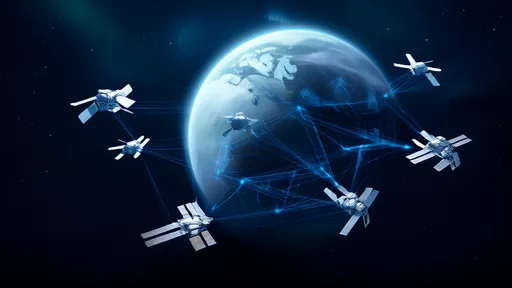
The race to build a quantum internet has entered a pivotal new phase as global satellite constellations take center stage. Governments and private enterprises are pouring billions into orbital infrastructure designed to enable unhackable communication through quantum entanglement. This represents not just an evolution, but a revolution in how information will be secured and transmitted across the planet.
China's Micius satellite network has demonstrated quantum key distribution (QKD) between ground stations separated by 7,600 km - a staggering achievement considering the delicate nature of quantum states. Meanwhile, the European Space Agency's SAGA mission and DARPA's Quantum Links initiative are testing fundamentally different approaches to maintaining quantum coherence across vast distances. The technological diversity suggests we're witnessing multiple pathways to the same destination rather than a single standardized approach.
What makes satellite-based quantum networks particularly compelling is their ability to overcome the distance limitations of fiber-optic systems. While ground-based quantum repeaters struggle with signal loss beyond a few hundred kilometers, satellites can create entanglement links between continents. Recent experiments show quantum signals surviving atmospheric entry with sufficient fidelity for cryptographic applications, though maintaining these states for extended periods remains challenging.
The business implications are profound. Financial institutions are particularly interested in quantum-secured transactions, with several major banks conducting pilot programs for intercontinental fund transfers. Intelligence agencies see potential for surveillance-proof diplomatic channels, while healthcare researchers anticipate quantum-encrypted genomic data sharing. This isn't merely about faster internet - it's about creating an entirely new class of trusted communication.
Technical hurdles persist at every level. Satellite-based quantum memories need to operate at near-absolute zero temperatures while withstanding solar radiation. Ground stations require unprecedented pointing accuracy to track moving satellites while detecting single photons. Perhaps most crucially, the entire system must maintain quantum coherence during the handoff between space and terrestrial segments - a problem that has defeated multiple research teams.
Regulatory frameworks haven't kept pace with the technology. The Outer Space Treaty doesn't address quantum frequency allocation, and there's no international consensus on standards for quantum encryption. Some legal experts warn of potential conflicts when quantum networks cross jurisdictions with differing data protection laws. These governance gaps could delay deployment even as the technical solutions mature.
Military applications add another layer of complexity. Quantum networks promise secure command-and-control systems immune to conventional cyber attacks, making them highly attractive for defense purposes. However, this very capability risks triggering a new arms race in quantum warfare technologies. Several nations have already classified their quantum satellite programs, limiting academic collaboration.
The environmental impact of large quantum satellite constellations remains understudied. While individual satellites are small, the required network density could contribute to space debris. Some researchers propose using quantum links themselves for debris tracking - an elegant solution that would turn the network into its own monitoring system.
Looking ahead, the next five years will likely see hybrid architectures emerge, combining satellite links with select terrestrial quantum backbones. This approach would leverage the strengths of both technologies while mitigating their respective weaknesses. Success will depend on breakthroughs in quantum error correction and novel materials that can preserve quantum states under real-world conditions.
What's becoming clear is that the quantum internet won't simply replace classical networks, but will operate alongside them for specialized applications. The satellites now being launched are laying the foundation for a communication paradigm that could prove as transformative as the original internet - if not more so. As these systems achieve operational status, they'll redefine what's possible in secure global communication.

By /Aug 14, 2025

By /Aug 14, 2025

By /Aug 14, 2025
By /Aug 14, 2025

By /Aug 14, 2025

By /Aug 14, 2025

By /Aug 14, 2025

By /Aug 14, 2025

By /Aug 14, 2025

By /Aug 14, 2025

By /Aug 14, 2025

By /Aug 14, 2025

By /Aug 14, 2025

By /Aug 14, 2025

By /Aug 14, 2025
By /Aug 14, 2025
By /Aug 14, 2025

By /Aug 14, 2025

By /Aug 14, 2025

By /Aug 14, 2025
