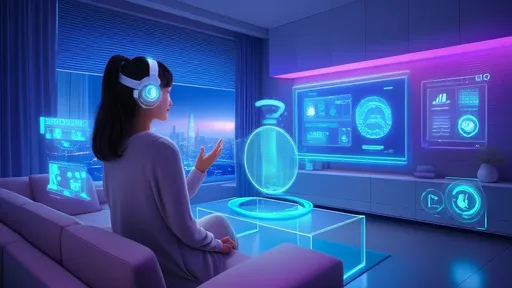
The concept of controlling our environment with mere thoughts has long been the stuff of science fiction. Yet, recent advancements in brain-computer interface (BCI) technology are bringing this futuristic vision closer to reality. The consumerization of BCI—particularly in the realm of smart home control—is no longer a distant dream but an emerging market poised to redefine how we interact with technology. Companies are racing to develop wearable and non-invasive devices that translate neural signals into actionable commands, allowing users to dim lights, adjust thermostats, or even brew coffee with nothing more than a focused intention.
The Science Behind Thought-Controlled Smart Homes
At the core of this revolution lies the ability to decode electrical activity in the brain. Modern BCI systems use electroencephalography (EEG) or near-infrared spectroscopy (NIRS) to detect subtle changes in neural patterns associated with specific intentions. For instance, imagining "turning on the lights" generates a distinct signal that machine learning algorithms can recognize after training. These signals are then wirelessly transmitted to IoT-enabled devices, creating a seamless loop between mind and machine. What was once limited to clinical settings—helping paralyzed patients operate prosthetics—is now being miniaturized into sleek headbands or earpieces for mainstream use.
Breaking Barriers: From Medical to Mainstream
The shift from medical-grade BCIs to consumer products hasn’t been without challenges. Early adopters must contend with limitations like signal interference from muscle movements or the need for frequent recalibration. However, companies like Neurable and NextMind have made strides in improving accuracy while reducing form factor. Their devices leverage dry electrode technology and adaptive AI that learns individual brain patterns over time. This democratization mirrors the trajectory of voice assistants—once clunky and niche, now ubiquitous. The key differentiator? Thought control eliminates the friction of wake words or manual inputs, offering what proponents call "true ambient computing."
Privacy Concerns in the Age of Neurotechnology
As with any data-driven technology, brainwave hacking emerges as a legitimate concern. Unlike passwords or fingerprints, neural signatures are biologically intrinsic and potentially vulnerable to exploitation. Could advertisers one day detect subconscious preferences during a smart TV session? Might insurers access stress-level analytics without consent? Regulatory bodies are scrambling to establish neuroethics frameworks, while manufacturers emphasize local signal processing—ensuring raw EEG data never leaves the device. Transparency reports from startups like Muse show promise, but the industry must prioritize security before achieving mass adoption.
The Silent Battle for Market Dominance
Tech giants are quietly positioning themselves in this space. Facebook’s defunct "typing-by-brain" project hinted at long-term interest, while Elon Musk’s Neuralink, though focused on implants, accelerates mainstream acceptance of neurotech. Meanwhile, Asian manufacturers lead in affordable consumer BCIs, with Shenzhen-based companies releasing sub-$200 headsets compatible with Xiaomi’s smart ecosystem. Analysts predict a bifurcated market: premium medical-grade devices for accessibility applications versus entertainment-focused products for gaming and home automation. The tipping point may come when Apple or Samsung integrates BCI into wearables—a move rumored to be in prototyping phases.
Beyond Convenience: The Unexpected Use Cases
While smart homes dominate headlines, lesser-known applications reveal BCI’s transformative potential. Imagine "neuro-adaptive" environments where rooms sense concentration levels and mute distractions automatically. Hotels experiment with thought-checked rooms to enhance guest experience, while architects design spaces that alter lighting based on occupants’ cognitive states. In Japan, trials show dementia patients using BCI to control ambient cues that improve circadian rhythms. These innovations suggest that thought-controlled interfaces aren’t just about replacing remotes—they could fundamentally alter how spaces respond to human presence.
The Road Ahead: Challenges and Possibilities
Current systems still require conscious, exaggerated thoughts (like visualizing a light switch) rather than effortless subconscious control. Next-generation BCIs aim to tap into passive signals—detecting fatigue to adjust room temperature or recognizing frustration to soften lighting. Materials science breakthroughs in graphene electrodes may soon enable invisible, tattoo-like sensors. As 5G networks reduce latency, cloud-based neural processing could enable real-time environmental adaptations across entire smart cities. The convergence of BCI with augmented reality (AR) hints at interfaces where users "think" virtual controls into existence.
The consumer BCI revolution is unfolding not with a bang, but through incremental integrations that normalize mind-machine symbiosis. Within this decade, asking Alexa to play a song may seem as archaic as dial-up internet. As one MIT researcher quipped, "The best interface is no interface—or rather, the one already inside our skulls." Whether humanity is psychologically prepared for such intimacy with technology remains the most profound unanswered question.

By /Aug 14, 2025

By /Aug 14, 2025
By /Aug 14, 2025

By /Aug 14, 2025

By /Aug 14, 2025

By /Aug 14, 2025

By /Aug 14, 2025
By /Aug 14, 2025

By /Aug 14, 2025

By /Aug 14, 2025

By /Aug 14, 2025

By /Aug 14, 2025

By /Aug 14, 2025

By /Aug 14, 2025

By /Aug 14, 2025

By /Aug 14, 2025

By /Aug 14, 2025

By /Aug 14, 2025

By /Aug 14, 2025

By /Aug 14, 2025
